
 Rackmount PC
 Embedded Computing
 Industrial Portable Computers
 Rugged Tablets
 Rugged Laptop
 Industrial Panel PC
 Rugged Handheld
 Advantech Industrial PC
Embedded Computer Uses Explained: Key Applications Across Manufacturing, Healthcare, and Transportation
2024-08-13 16:29:49
Table of Contents
- 1. What Is an Embedded Computer?
- 2. Embedded Computer Architectures & Form Factors
- 3. Typical Embedded Computers Applications by Sector
- 4. Advanced Use Cases & Emerging Trends
- 5. Benefits, Limitations & Design Constraints
- 6. Connectivity Ecosystems
- 7. How to Select the Right Embedded Computer?
- 8. Embedded Computer vs Ordinary Personal PC
- 9. Future Outlook & Conclusion
- 10. FAQ
1. What Is an Embedded Computer?
An embedded computer is a specialized computing device integrated into a larger mechanical or electrical system. It’s not designed to be interacted with directly like a laptop or desktop but to run real-time operations in applications such as industrial automation, smart homes, medical devices, and vehicles.
Key characteristics:
- Task-specific functionality
- Compact form factor
- Low power consumption
- Real-time performance
- Long lifecycle and high reliability

2. Embedded Computer Architectures & Form Factors
2.1. Common Embedded Form Factors
Embedded computers are available in a range of physical layouts to suit varying operational constraints:
-
Box PCs:
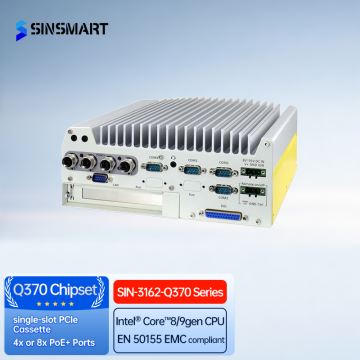
Compact and fanless, these are ideal for harsh industrial environments. Industrial mini pcs are often DIN rail- or VESA-mounted in factory settings. -
Panel PCs:
Industrial Panel PC Combine a touchscreen display with embedded processing. Common in HMIs (Human-Machine Interfaces) for automation, healthcare kiosks, and marine controls. -
Single Board Computers (SBCs):
Include CPU, memory, I/O, and storage on a single board. Popular in edge applications where space and cost are critical (e.g., Raspberry Pi, BeagleBone). -
System-on-Module (SoM) and Computer-on-Module (CoM):
Plug into a carrier board, offering modularity and upgrade flexibility. Used in custom industrial and automotive designs.
Key Architecture Considerations
| Architecture Type | Description | Common Use Cases |
|---|---|---|
| System-on-Chip (SoC) | CPU, GPU, RAM, and I/O integrated into one chip | Consumer devices, wearables, low-power IoT |
| Socket-based CPU | Modular CPU with separate RAM and storage modules | Industrial PCs, high-performance systems |
| Fanless Design | Passive cooling with heatsinks or enclosures | High-dust or vibration-prone environments |
| Ruggedized Builds | Wide-temp, shock-resistant, waterproof (IP65+) enclosures | Transportation, mining, defense sectors |
2.2. Choosing the Right Form Factor
The decision depends on several application-specific variables:
Thermal constraints (e.g., fanless for silent or dusty areas)
Available space (cabinet-mounted vs handheld vs in-wall)
Input/output needs (USB, COM, LAN, GPIO, CAN bus)
Power supply (9–36V DC input is common in mobile/vehicle deployments)
Certifications (e.g., CE, FCC, UL, MIL-STD-810G)
3. Typical Embedded Computers Applications by Sector
3.1. Industrial & Manufacturing Automation
In industrial environments, embedded computers are at the heart of:
-
Programmable Logic Controllers (PLCs) and SCADA systems
-
Robotic arms and CNC machinery
-
Smart sensors and industrial gateways
These systems support real-time control, enabling factories to achieve predictive maintenance, process automation, and edge analytics.
3.2. Automotive & Transportation
Modern vehicles integrate dozens of embedded computers. These include:
-
Engine Control Units (ECUs) for fuel management
-
Advanced Driver Assistance Systems (ADAS) for collision avoidance
-
Infotainment and Navigation Systems
-
Battery Management Systems (BMS) in electric vehicles
Vehicle-grade embedded computers must meet ISO 26262 safety standards and tolerate shock, vibration, and voltage fluctuations.
3.3. Healthcare & Medical Devices
From hospital equipment to personal wearables, embedded systems ensure:
-
Continuous patient monitoring (heart rate, oxygen, glucose)
-
Imaging and diagnostic systems (MRI, ultrasound)
-
Infusion pumps and surgical robotics
3.4. Consumer Electronics & Smart Homes
Embedded computers are everywhere in the home:
-
Smart thermostats
-
Security cameras
-
Voice assistants
-
Appliances with touch interfaces
These devices often use low-power ARM-based SoCs, optimized for wireless connectivity, minimal latency, and cloud integration.
3.5. Retail, Banking & Infrastructure
In public-facing environments, embedded systems drive:
-
Digital signage
-
Self-checkout kiosks
-
Point-of-sale terminals
-
ATM and ticketing machines
Such systems require touch interfaces, remote diagnostics, and anti-vandal enclosures for uninterrupted uptime.
3.6. Aerospace, Telecom & Defense
In high-stakes environments, embedded computers must endure:
-
Extreme altitude and temperature
-
High electromagnetic interference
-
Stringent data security requirements
4. Advanced Use Cases & Emerging Trends
As industries shift towards autonomous systems, edge computing, and AI-powered decision-making, embedded computers are no longer limited to simple control duties. They are now a critical enabler of intelligent edge applications ranging from real-time analytics to localised machine learning. This change propels the creation of more powerful, small, and energy-efficient embedded platforms.
4.1. Edge AI & Embedded Inference
Embedded computers are now capable of running AI models locally, eliminating the need to send data to the cloud. This is critical for applications that require:
-
Low latency (e.g., object recognition on a production line)
-
Data privacy (e.g., in medical or defense environments)
-
Offline functionality (e.g., drones or remote sensors)
4.2. TinyML and Intermittent Computing
TinyML refers to the deployment of lightweight ML models on ultra-low-power microcontrollers. These systems are ideal for battery-operated or energy-harvesting devices such as:
-
Wearable fitness monitors
-
Wildlife tracking beacons
-
Smart agriculture sensors
4.3. Embedded Systems in Robotics and Autonomous Vehicles
The rise of autonomous mobile robots (AMRs), drones, and AGVs (automated guided vehicles) is accelerating the demand for real-time sensor fusion, SLAM algorithms, and path planning — all supported by rugged embedded computers.
These platforms must offer:
-
High-performance compute in compact size
-
Multiple camera inputs, LIDAR, and IMU integration
-
Support for ROS (Robot Operating System)
4.4. Connectivity & Decentralized Edge Infrastructure
Next-gen embedded pcs are designed to act as micro data centers, offering:
-
5G, Wi-Fi 6, or LPWAN support
-
Onboard container orchestration (e.g., Docker, Kubernetes Lite)
-
Compatibility with MQTT, OPC UA, and Modbus for industrial IoT
5. Benefits, Limitations & Design Constraints
5.1. Key Benefits of Embedded Computers
High Reliability & Uptime
- Resistant to vibration, dust, water, and electromagnetic interference.
- Capable of stable operation in wide temperature ranges (commonly -20℃ to 60℃).
- Rigorously tested to meet industrial-grade standards for long-term reliability.
Compact Form Factor
Low Power Consumption
- Equipped with low-power processors and optimized hardware design to minimize energy use and heat generation.
- Ensures long-term, stable operation, especially suitable for unattended applications.
Real-Time Processing
- Compatible with real-time operating systems (RTOS) or industrial software platforms.
- Delivers real-time response for automation, robotics, and traffic control applications.
Longevity & Industrial Certifications
- Built with industrial-grade components to ensure extended supply cycles.
- Long service life with low maintenance costs.
Fanless Cooling (Passive Heat Dissipation)
- Uses aluminum alloy enclosures or specialized thermal structures for efficient heat dissipation.
- Eliminates noise and vibration, reduces dust intrusion, and extends device lifespan.
Rich Interfaces and Expansion Options
- Provides diverse industrial interfaces such as USB, LAN, COM, GPIO, CAN, and PCIe.
- Supports customization and expansion to meet specific application requirements.
Wide Range of Applications
- Industrial automation, energy, power, transportation, logistics, medical, security, agriculture, and autonomous driving.
- Plays a vital role in emerging fields such as IoT, smart manufacturing, and smart cities.
5.2. Common Limitations and Trade-Offs
| Limitation | Description |
|---|---|
| Limited Compute Resources | Typically no GPU (unless dedicated); unsuitable for large-scale processing |
| Difficult to Update | OTA (over-the-air) updates can be limited or unavailable |
| Less Flexibility | Designed for a specific use-case; cannot repurpose easily |
| Thermal Constraints | Passive cooling may lead to throttling under high load |
| Development Complexity | Hardware-specific programming (firmware, RTOS) requires specialized skills |
5.3. Key Design Constraints in Embedded Engineering
Embedded systems must work within a tightly defined SWaP-C envelope:
-
Size: Devices often must fit inside enclosures, dashboards, or machine housings.
-
Weight: Especially important in automotive, aerospace, and wearables.
-
Power: Limited energy availability (battery-operated, solar-powered).
-
Cost: Tight budgets for consumer and mass-produced industrial hardware.
5.4. Environmental Considerations
Embedded computers are frequently exposed to harsh conditions. Design considerations may include:
-
Operating temperature range: –40°C to +85°C for outdoor or in-vehicle use
-
Ingress protection: IP65/IP67 rating for dust and water resistance
-
Shock and vibration tolerance: Certified to MIL-STD or EN50155
6.Connectivity Ecosystems
6.1. Physical Connectivity Interfaces
Embedded computers support a broad range of I/O interfaces to integrate with other hardware systems, sensors, actuators, and controllers.
-
Serial ports (RS-232/422/485): Legacy support in industrial control, sensors, meters
-
USB: For peripherals, cameras, data logging devices
-
Ethernet (1G/2.5G/10G): Backbone for industrial automation and local data transfer
-
CAN Bus: Widely used in automotive and robotics for real-time communication
-
GPIO: Basic digital signal control (e.g., on/off, trigger input/output)
-
HDMI/DisplayPort: For touchscreen displays or operator panels
6.2. Wireless Connectivity Standards
Wireless support enables mobile, remote, or difficult-to-wire installations. Popular options include:
| Wireless Standard | Use Case | Notes |
|---|---|---|
| Wi-Fi | Retail kiosks, smart buildings | Easy integration, moderate range |
| Cellular (4G/5G) | Outdoor systems, fleet tracking, kiosks | Reliable in remote areas |
| Bluetooth/BLE | Wearables, sensors, low-energy use | Short-range, energy-efficient |
| LoRaWAN/NB-IoT | Agriculture, utility metering, smart city | Ultra-low power, long-range |
| Zigbee/Z-Wave | Home automation, lighting control | Mesh network capabilities |
6.3. Cloud & Edge Integration
Modern embedded systems are often deployed as part of a distributed network, connecting either to edge servers or cloud platforms for centralized monitoring and data aggregation.
-
MQTT and CoAP: Lightweight protocols for IoT messaging
-
OPC UA / Modbus TCP: Industrial interoperability standards
-
HTTPS/WebSocket: For secure browser-based control and monitoring
-
Remote management tools: For OTA updates, diagnostics, and logging
7. How to Select the Right Embedded Computer?
Choosing the correct embedded computer necessitates a thorough understanding of your application's environment, performance requirements, and lifetime expectations. Unlike desktop computers, embedded computers must be chosen based on purpose-built parameters, such as operating temperatures and I/O compatibility, to ensure long-term, reliable operation in the field.
7.1. Define the Application Use Case
The first step is to determine where and how the device will be used:
-
Industrial automation: Needs wide-temp range, serial I/O, and DIN-rail mount
-
Medical diagnostics: Requires fanless design, IEC 60601 compliance, and long lifecycle
-
Smart kiosks: Demands multimedia support, touch display output, and Wi-Fi/4G
-
Mobile/vehicle use: Needs wide voltage input, ignition sensing, shock resistance
7.2. Match Compute Performance to Task Complexity
| Task Type | Recommended Platform | CPU Class |
|---|---|---|
| Basic I/O control (e.g., relay switching) | Microcontroller or SoC | ARM Cortex-M/R |
| Real-time monitoring (e.g., sensor fusion) | Industrial SBC | Intel Atom / ARM A72 |
| Machine vision, AI, inference | Edge AI box PC | Intel Core / NVIDIA Jetson |
| Multitasking + GUI (e.g., kiosks) | Panel PC or fanless box PC | Intel Core i5/i7 |
7.3. Choose the Right Form Factor & Mounting
-
Box PCs: Versatile, often fanless, ideal for industrial cabinets
-
Panel PCs: Integrate display and compute; used in HMI, kiosks
-
SBCs/SoMs: Ideal for space-limited, low-power applications
-
Rugged tablets or mobile terminals: For field data capture and vehicle mounting
Check for mounting options: DIN rail, VESA, rack, wall, or custom brackets.
7.4. Consider I/O and Peripheral Needs
Key I/O questions include:
-
How many serial ports, LAN ports, or USB devices are required?
-
Are CAN bus, PoE, or GPIO essential for your workflow?
-
Will the system need to support touchscreen, barcode scanner, or RFID reader?
Ensure the board or chassis includes expandable options (e.g., Mini PCIe, M.2, or SIM slots) if future upgrades are likely.
7.5. Evaluate Compliance and Lifecycle Support
Depending on the industry, the system may need to meet certifications such as:
-
CE/FCC/UL: General compliance
-
EN50155: Railway systems
-
IEC 60601: Medical equipment
-
MIL-STD-810G: Military-grade ruggedness
Also confirm the availability of long-term supply (often 7+ years) and BIOS/firmware support.
8. Embedded Computer vs Ordinary Personal PC
If you are looking for a computing solution that is compact, reliable, and built for tough environments, an embedded computer (also known as an embedded industrial PC) is the perfect choice. Unlike traditional desktop PCs, these systems are designed with space-saving structures, fanless cooling, and low power consumption, making them highly efficient for long-term operation.
They are engineered to withstand vibration, dust, water, and extreme temperatures, ensuring stable performance even in harsh industrial settings. With a wide range of I/O interfaces and flexible expansion options, embedded computers can be easily adapted to applications in industrial automation, energy, transportation, healthcare, security, logistics, and beyond.
In short, an embedded computer is not just small and durable—it is a dependable partner for industries moving toward IoT, smart manufacturing, and smart cities.
| Feature | Embedded Computer | Traditional PC |
| Design & Build | Compact, rugged, fanless, industrial-grade components | Consumer-grade, focused on performance and cost |
| Reliability | High, stable in harsh environments, vibration/dust/water resistant | Moderate, suitable for office/home use |
| Operating System | RTOS, Windows IoT, Linux; real-time and customizable | Windows, macOS, Linux; general-purpose |
| Software | Industrial software: PLC, SCADA, EMS, MES | Office, multimedia, games, general applications |
| Interfaces & Expansion | Rich I/O ports, flexible expansion, industry-specific interfaces | Standard ports (USB, HDMI), limited expansion |
| Power & Cooling | Low-power, fanless or optimized cooling | Higher power consumption, fan-cooled |
| Application Scenarios | Industrial automation, energy, transport, healthcare, IoT | Office, education, entertainment, home use |
| Lifecycle & Support | Long lifecycle, manufacturer maintenance and customization | Shorter lifecycle, basic consumer support |
9. Future Outlook & Conclusion
As technology continues to push boundaries, embedded computers are evolving far beyond their traditional roles. Once limited to basic control and monitoring, they now serve as AI-enabled edge platforms, real-time analytics engines, and secure connectivity hubs across industries. Their future is not only promising — it is foundational to the next wave of innovation.
FAQ
1. What industries benefit most from embedded computers?
2. How do embedded computers differ from traditional PCs in terms of reliability?
3. Can embedded computers support AI or advanced data processing?
4. What connectivity options are available for embedded computers?
5. How should I select the right embedded computer for my application?




LET'S TALK ABOUT YOUR PROJECTS
- sinsmarttech@gmail.com
-
3F, Block A, Future Research & Innovation Park, Yuhang District, Hangzhou, Zhejiang, China
Our experts will solve them in no time.